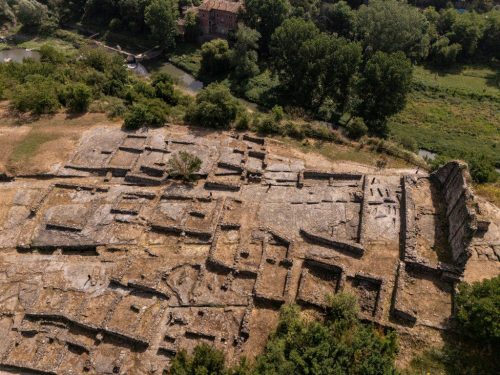
The Jaciment Arqueològic de l’Esquerda is a key site for understanding the historical and cultural evolution of inland Catalunya.
Situated on a peninsula surrounded by the Ter River, the site was occupied from the 8th century BC until the 14th century AD. It preserves evidence of more than 2,500 years of history: from the Late Bronze Age through the Iberian, Visigothic and Carolingian periods and the Late Middle Ages, until its abandonment in 1314.
L’Esquerda was home to the capital of the Iberian Ausetani people: Ausa, with an imposing defensive wall and large towers, a street running from north to south, workshops and remains of a possible sanctuary. It was also home to a notable fortified medieval town, initially known as Roda Ciutat and, from the 11th century onwards, as Sant Pere de Roda, with streets, houses and a Romanesque church surrounded by its necropolis. Excavations have revealed an important agricultural and defensive complex.

 Hostalric